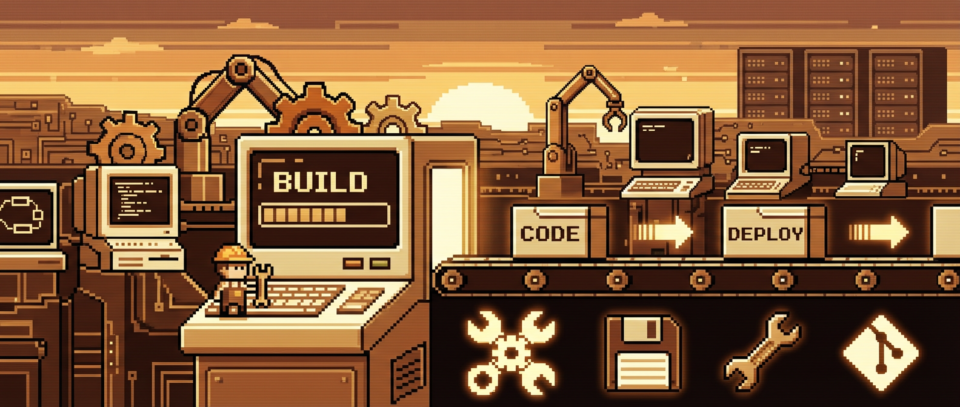
The Great Deploy Disaster of 2019
Picture this: It’s Friday evening, the team is already mentally checked out for the weekend, and I’m pushing what should be a trivial hotfix to production. Thirty seconds later, our entire payment processing pipeline is down, customers can’t complete purchases, and my phone is vibrating so violently it’s practically levitating off my desk. The culprit? A missing environment variable that existed on my machine but nowhere else, because apparently I’d been running with a custom .env file for six months and forgot it existed.

This wasn’t my first rodeo with deployment disasters, but it was definitely the most expensive. As I sat there rebuilding the service at 11 PM while our CEO sent increasingly creative emoji combinations via Slack, I had what you might call a moment of clarity. The manual deployment process that had worked fine when we were five engineers was now a ticking time bomb with a team of twenty. We needed to automate everything, and we needed to do it yesterday.
The irony is that I’d been pushing for better tooling for months, but like many senior engineers, I suffered from the classic “I can do this faster myself” syndrome. Turns out, doing it faster myself was exactly the problem.

Building the Perfect Deployment Machine
After that memorable Friday night, I spent the weekend designing what would become our deployment salvation. The requirements were simple: zero-click deployments, environment parity guarantees, and enough safeguards to prevent future versions of myself from breaking things. The implementation, naturally, was anything but simple.
I started with GitHub Actions because, let’s face it, staying within the Microsoft ecosystem meant fewer authentication headaches. The first version was embarrassingly basic: run tests, build Docker image, push to registry, trigger deployment. But the devil, as always, was in the details. How do you handle secrets management across environments? What about database migrations? Rolling deployments? Blue-green switches?
The breakthrough came when I realized I was thinking about this backwards. Instead of trying to automate our existing chaotic process, I needed to design a process that was built for automation. This meant standardizing everything: environment configurations, deployment targets, health check endpoints, rollback procedures. It took three weeks to build and another two to convince the team to actually use it, but the result was beautiful in its predictability.
The best part? The system was paranoid by design. It checked environment variables against a schema, validated database connections before migrations, ran health checks at every step, and kept detailed audit logs. It was like having a very meticulous, very caffeinated junior developer double-checking everything.
The Unexpected Joy of Configuration as Code
Here’s something nobody tells you about automation: the real magic happens when you stop thinking about individual deployments and start thinking about infrastructure as a living, breathing system. Once our deployment pipeline was solid, I got drunk on the possibilities and decided to tackle our development environment setup.
Previously, onboarding a new engineer meant a full day of “install this, configure that, pray it works on your specific combination of OS version and local dependencies.” Our setup documentation was a 47-step Google Doc that was somehow both overly detailed and completely wrong. I knew we could do better.
The solution was a combination of Docker Compose for local development, Terraform for cloud resources, and a collection of make targets that made everything Just Work™. New engineers could now run `make setup` and have a fully functional development environment in under ten minutes. Database seeds, service dependencies, local certificates, monitoring dashboards, everything appeared automatically.
But the real win wasn’t the time savings. It was killing environmental drift, those subtle differences between development machines that cause the infamous “works on my machine” bugs. When everyone’s running identical containerized environments, debugging becomes dramatically easier. No more spending hours troubleshooting an issue that only happens on Sarah’s MacBook because she installed a different version of Node six months ago.
Monitoring: The Unsung Hero of Automation
Automation without observability is like flying blind in a thunderstorm. You might reach your destination, but you probably won’t enjoy the journey. After our deployment pipeline was humming along nicely, the next obvious step was making sure we could see when things went sideways.
I integrated monitoring into every aspect of our automation. Build times, deployment success rates, test coverage metrics, dependency update frequencies. If it could be measured, it got measured. The key insight was treating our development tools with the same operational rigor we applied to production services. Our CI/CD pipeline became a first-class citizen with its own dashboards, alerts, and SLAs.
The payoff was immediate. When deployment times started creeping up, we could identify bottlenecks before they became painful. When test flakiness increased, we could correlate it with specific changes. When our dependency update automation started failing, we knew within minutes instead of discovering it weeks later during a security audit.
My favorite addition was a Slack bot that posted deployment summaries with relevant metrics, recent changes, and predicted rollback procedures. It transformed deployments from anxiety-inducing events into routine status updates. The bot even learned to celebrate successful deployments with increasingly elaborate emoji compositions, which somehow made the whole team more invested in keeping the pipeline green.
The Philosophy of Productive Paranoia
Three years later, our automation has evolved into something I genuinely love working with. It’s not perfect, nothing ever is, but it’s reliable, predictable, and continuously improving. The most important lesson I learned is that good automation isn’t about eliminating human judgment, it’s about encoding the good judgment so it happens consistently.
Every guard rail in our system exists because someone, usually me, made a specific mistake at a specific time. The environment variable validation? Friday night disaster number one. The mandatory integration tests before production deploys? That would be disaster number two, involving a database migration that worked perfectly in staging but spectacularly failed in production because of data volume differences. The automatic rollback triggers? Let’s just say disaster number three was particularly educational.
The beautiful thing about automation is that it’s learning made permanent. Every failure becomes a permanent lesson, written into configuration and enforced by machines that never forget, never get tired, and never decide to skip steps because they’re running late for lunch. It’s like having a team of incredibly pedantic interns who never sleep and are absolutely obsessed with following procedures.
What started as a desperate response to broken deployments has become the foundation of how we ship software. Our automation doesn’t just prevent disasters, it enables confidence. When you know the system will catch your mistakes, you’re more willing to experiment, refactor, and push boundaries. That’s when the real magic happens.
If you’re dealing with similar deployment chaos or just curious about specific implementation details, I’d love to hear about your own automation war stories. The best solutions always come from sharing battle scars and comparing notes on what actually works in practice.