
The Workspace Promise and the Reality Check
Last November, I watched GitHub Copilot Workspace hit general availability and felt that familiar flutter of excitement mixed with skepticism. Here was a tool promising to take you from issue description to merged pull request without ever leaving your browser. Eighteen months ago, that sounded like science fiction. Now it’s here, and over 1.8 million developers are actively using it within the first six months. The hype machine was real, and honestly, some of it was deserved.
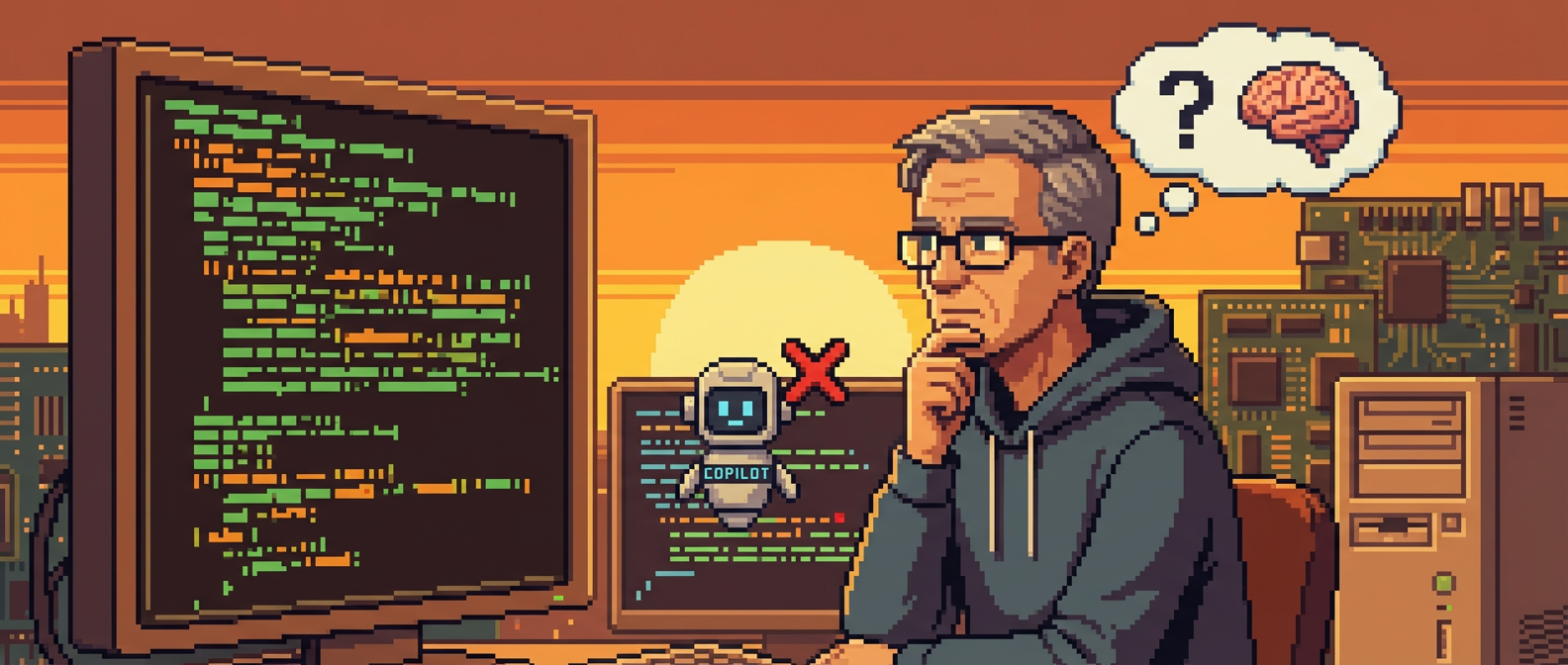
But here’s what I’ve learned after two and a half decades of shipping code: tools that promise to eliminate your job are usually just moving the problem somewhere else. Rarely eliminating it. Copilot Workspace is genuinely useful. I’m not being cagey about that. But I’ve also spent the last few months watching it fail in ways that confirm something important: the judgment that separates a senior engineer from a productivity suite is not about generating code faster. It’s about knowing which code shouldn’t be written in the first place.

Where the Logic Errors Hide
A Stack Overflow survey from late 2025 found that 76% of developers using AI coding tools were still spending substantial time fixing logic errors in code adjacent to production systems. That number should scare you a little. It should also not surprise you at all. I’ve been watching this play out in pull request reviews for months now.
The AI understands syntax. It understands patterns. What it doesn’t reliably understand is the business logic that makes your specific system tick. Last quarter, I caught Copilot Workspace generating a perfectly valid sorting algorithm in an ecommerce pipeline that would have nuked our customer tier validation logic. The code was syntactically flawless. It would have compiled. It would have passed basic unit tests. But it made an assumption about data immutability that only holds true in exactly three cases out of the twelve different execution paths in our actual system.
A senior engineer spots that because they’ve traced those execution paths before. They’ve debugged the weird edge case at 3 AM when a customer’s quarterly order didn’t process right. They know where the landmines are buried. Copilot Workspace generates beautiful code in the sunny scenarios. Real systems, with all their Byzantine complexity, trip it up every single time.
The Code Churn Problem Nobody Wants to Admit
Here’s the data point that actually keeps me up at night. GitClear published research in early 2026 showing that AI-assisted codebases had a 41% increase in code churn compared to their pre-AI baselines. Code churn means rewriting code that was recently committed. It means instability. It means that thing you thought was done is getting rewritten within weeks because it didn’t work the way everyone assumed it would.
When I first read that report, I felt validated in a way I didn’t expect. My team’s churn metrics had ticked up since we started leaning more heavily on Copilot Workspace. We assumed it was because we were moving faster, shipping more, breaking more things. Turns out we were just rewriting more things. There’s a difference, and it’s an expensive one.
The pattern I’ve observed is this: Copilot Workspace helps you write code 30% faster. But if that code is going in the wrong direction strategically, you’ve just accelerated the wrong journey. Half a senior engineer’s job is knowing when to step back and say “wait, are we solving the right problem?” That’s not a code generation question. It’s an architecture question. A judgment question.
Why the Competition Is Getting Scary
I need to be honest about something. The bar for what AI can do is rising faster than I expected. Anthropic released Claude 3.7 Sonnet in February 2026 with an extended thinking mode that hit a 70.3% resolution rate on SWE-bench Verified. That’s the kind of benchmark that makes you sit up in your chair. It outperforms GPT-4o on complex software engineering problems. The gap between “good at boilerplate” and “good at reasoning about complex systems” is closing.
Does that terrify me? Not entirely. It should make me more thoughtful. These tools are genuinely getting better at the kinds of problems that require actual reasoning. But raw benchmark performance on standardized tests doesn’t translate neatly to production judgment. I can throw a complex problem at Claude 3.7 in extended thinking mode and get a legitimately impressive solution. Then I deploy it to a system with three years of technical debt and custom middleware, and suddenly we’re talking about something completely different.
What Senior Judgment Actually Looks Like Now
So what does a senior engineer do when the tooling can generate code faster than they can think about whether the code should exist? Honestly, your job gets more interesting. You stop being a code generation unit. You become a filter, a strategist, and a remorse prevention specialist.
I’ve started using GitHub Copilot Workspace documentation as a productivity boost for the 40% of tasks where the requirements are crystal clear and the domain is well-understood. Then I spend my brainpower on the other 60%. That’s where I’m looking at three competing architectural approaches and understanding why we’re choosing one. That’s where I’m reading the code someone generated and asking “what assumptions does this make about our data flow?” That’s where I’m catching the thing that would have broken in production six weeks from now.
The GitClear 2025 AI Code Quality Report showed that the problem wasn’t the tools themselves. It was the judgment gap. Teams that succeeded with AI-assisted coding had senior people doing code review. Teams that just cranked out code and merged it saw quality degradation. That’s not a tool problem. That’s a process problem.
In 2026, being a senior engineer means knowing when to use Copilot Workspace to move fast and when to think slowly. It means recognizing that just because you can generate a solution in five minutes doesn’t mean you should deploy it in five hours. It means having the confidence to say “this code looks correct but I’m not sure it’s right” and digging deeper. No tool can do that for you. That’s judgment, and it’s never been more valuable.
What’s your experience been with this? Have you caught something that looked fine but would have exploded in production? I’d genuinely like to hear where your team is seeing the gaps.